Key features and components of a square roller conveyor belt system include:
- Stable and Controlled Movement: Square rollers or blocks provide a stable
and controlled surface for moving items. This design is particularly useful for conveying
products with flat or square bottoms, ensuring they remain securely in place during
transportation.
- Precise Product Orientation: Square roller conveyor belts are excellent
for maintaining precise product orientation. They can be used to align, turn, or rotate
items as they move along the conveyor.
- Types of Conveyor Belts:
- Flat Belt Conveyors: These
consist of a flat,
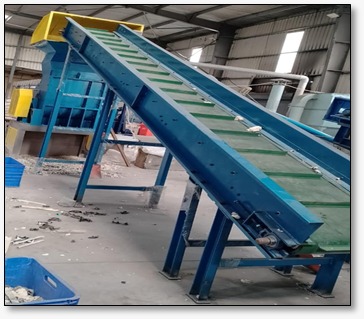
continuous loop of material that moves horizontally or with a slight incline.
- Roller Conveyors: These use a
series of rollers to move items along a path.
- Belted Incline or Decline
Conveyors: These have
an inclined or declined section to move items up or down.
- Bucket Conveyors: Designed to
move bulk materials
vertically.
- Screw Conveyors: Use a helical
screw to move
materials.
- Automation :Conveyor belts are often integrated into automated systems,
such as
assembly lines in manufacturing plants, baggage handling systems at airports, and
distribution centers in
warehouses. They can be programmed to transport items at specific speeds and intervals.
- Safety: Conveyor belts are equipped with various safety features to
prevent accidents,
such as emergency stop buttons, sensors to detect obstructions, and guardrails.
- Customization: Conveyor belts can be customized in terms of length, width,
and design
to meet the specific needs of a particular application.
- Maintenance: Regular maintenance is essential to ensure the proper
functioning of
conveyor belts. This includes cleaning, lubricating, and inspecting components to identify
and address any
wear or damage.
- Environmental Considerations: Conveyor belts can have environmental
impacts, such as
energy consumption and material waste. Efforts are made to optimize conveyor systems for
efficiency and
sustainability.
- Applications: Conveyor belts are used in a wide range of industries,
including
manufacturing, mining, agriculture, food processing, logistics, and more. They play a
crucial role in
streamlining production and distribution processes.
- Conveyor Belt Technology: Advancements in conveyor belt technology continue
to improve
efficiency and safety. For example, some systems now incorporate automation, sensors, and
IoT (Internet of
Things) technology to monitor and control conveyor operations.
In summary, conveyor belts are versatile tools that facilitate the movement of goods and
materials in
various industries, contributing to increased productivity and automation in manufacturing and
logistics
processes.